Whirlpool FFWDB 964489 BV SPT handleiding
Handleiding
Je bekijkt pagina 27 van 33
EN
Sort your laundry according to
Type of fabric/care label (cotton, mixed bres, synthetics, wool,
handwash items). Colour (separate coloured and white items, wash
new coloured items separately). Delicates (wash small items – like
nylon stockings – and items with hooks – like bras – in a cloth bag or
pillow case with zip).
Empty all pockets
Objects like coins or lighters can damage your laundry as well as the
drum.
Follow the dosage recommendation / additives
It optimizes the cleaning result, it avoids irritating residues of surplus
detergent in your laundry and it saves money by avoiding waste of
surplus detergent
Use low temperature and longer duration
The most ecient programmes in terms of energy consumption
are generally those that perform at lower temperatures and longer
duration.
Observe the load sizes
Load your washing machine up to the capacity indicated in the
“PROGRAMME CHART” table to save water and energy.
Noise and remaining moisture content
They are inuenced by the spinning speed: the higher the spinning
speed in the spinning phase, the higher the noise and the lower the
remaining moisture content.
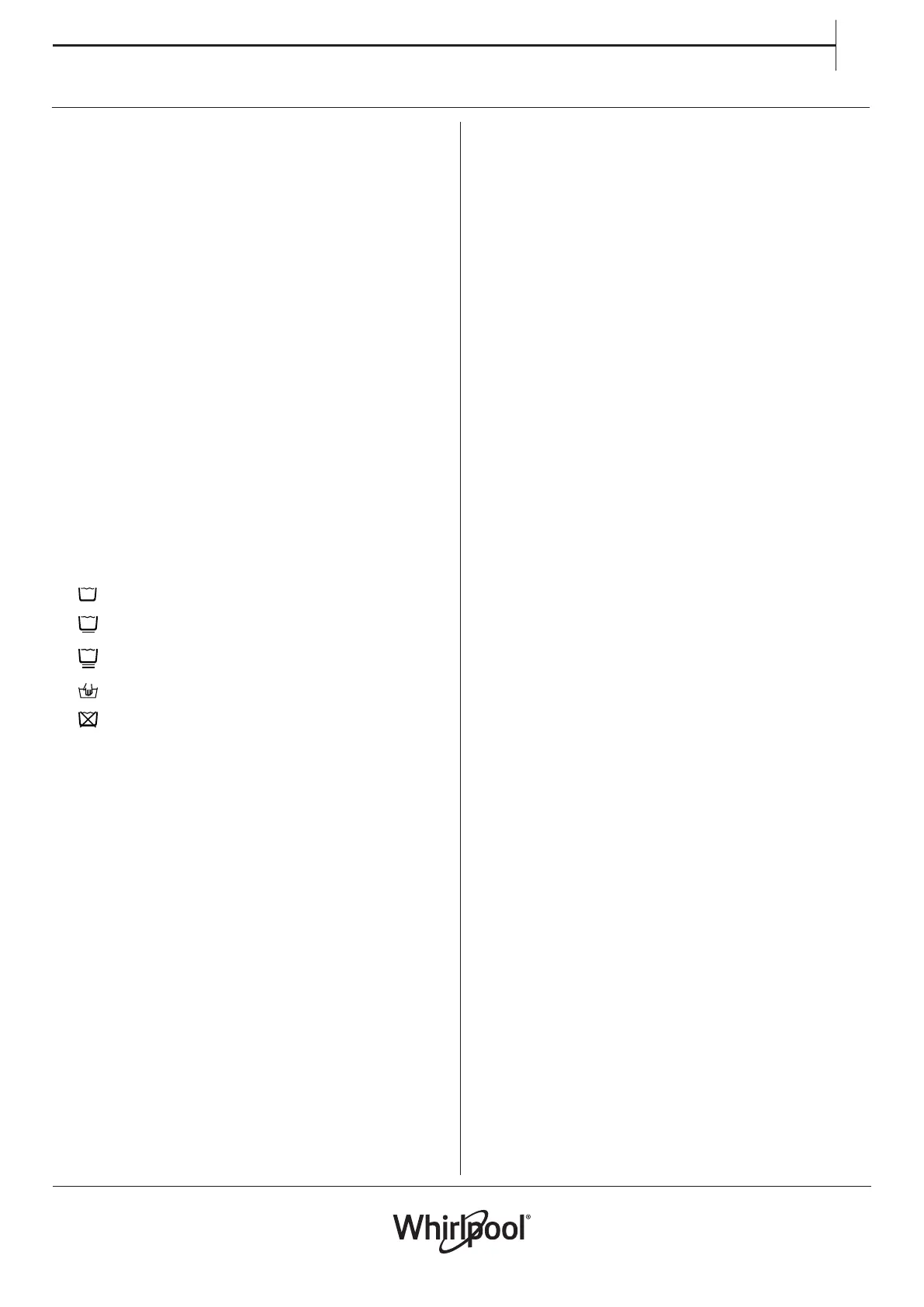
WASH SYMBOLS
ON GARMENT LABELS
The value given in the tub symbol is the maximum temperature
possible for washing the garment.
Normal mechanical action
Reduced mechanical action
Much reduced mechanical action
Hand wash only
Do not wash
CLEANING & MAINTENANCE
For any cleaning and maintenance, switch o and unplug the
washing machine. Do not use ammable uids to clean the washing
machine.
Clean and maintain your washing machine periodically (at least 4
times per year).
Cleaning the outside of the washing machine
Use a soft damp cloth to clean the outer parts of the washing
machine. Do not use glass or general purpose cleaners, scouring
powder or similar to clean the control panel – these substances
might damage the printing.
Checking the water supply hose
Check the inlet hose regularly for brittleness and cracks. If
damaged, replace it by a new hose available through our After-
Sales Service or your specialist dealer. Depending on the hose type:
If the inlet hose has a transparent coating, periodically check if
the colour intensies locally. If yes, the hose may have a leak and
should be replaced.
Cleaning the water lter / draining residual water
If you used a hot wash programme, wait until the water has cooled
down before draining any water. Clean the water lter regularly, to
avoid that the water cannot drain after the wash due to obstruction
of the lter.
Remove the plinth by using the screwdriver: push downwards one
side of the plinth with your hand, then push the screwdriver into
the gap between plinth and front panel and pry open the plinth.
Place a broad, at container beneath the water lter, to collect
the drain water. Slowly turn the lter counterclockwise until water
ows out. Let the water ow out, without removing the lter.
When the container is full, close the water lter by turning it in
clockwise. Empty the container. Repeat this procedure until all
the water has drained. Lay a cotton cloth beneath the water lter,
which can absorb a small amount of rest water. Then remove the
water lter by turning it out anti clockwise. Clean the water lter:
remove residues in the lter and clean it under running water.
Insert the water lter and reinstall the plinth: Reinsert the water
lter again by turning it in clockwise direction. Make sure to turn
it in as far as it goes; the lter handle must be in vertical position.
To test water tightness of the water lter, you can pour about
1 liter of water into the detergent dispenser. Then reinstall the
plinth.
Cleaning the detergent dispenser
Remove the detergent dispenser by pressing on the release
button and at the same time pulling out the detergent dispenser.
Remove the insert from the detergent dispenser, as well as the
insert of the softener compartment. Clean all parts under running
water, removing all detergent or softener residues. Wipe the parts
dry with a soft cloth. Reinstall the detergent dispenser and push it
back into the detergent compartment.
SAVING ENERGY AND PROTECTING THE
ENVIRONMENT
• Keeping within the load limits indicated in the programme
chart will optimise energy, water and detergent consumption
and reduce washing times.
• Do not exceed the detergent quantities recommended by the
detergent manufacturer.
• Save energy by using a 60°C instead of a 90°C wash
programme, or by using a 40°C instead of a 60°C wash
programme. We recommend using the Eco 40-60 programme
for cotton garments, which is longer but uses less energy.
• To save energy and time when washing and drying, select
highest spin speed available for the programme to reduce the
residual water remaining in the garments at the end of the
wash cycle.
HINTS AND TIPS
Bekijk gratis de handleiding van Whirlpool FFWDB 964489 BV SPT, stel vragen en lees de antwoorden op veelvoorkomende problemen, of gebruik onze assistent om sneller informatie in de handleiding te vinden of uitleg te krijgen over specifieke functies.
Productinformatie
| Merk | Whirlpool |
| Model | FFWDB 964489 BV SPT |
| Categorie | Wasmachine |
| Taal | Nederlands |
| Grootte | 4532 MB |