
Freggia WISL1050 handleiding
Handleiding
Je bekijkt pagina 11 van 52
EN
11
PRECAUTIONS AND ADVICE
Consumption data - Standard
Programma (5)
Spinning
e ciency
(4)
Maximum
spin
(rpm)
Standard programme time (5)
Noise level
washing
dB(A)
Noise
level
spinning
dB(A)
Dimensions and weight
Water
consumption/
cycle 60°C half
load L
Water
consumption/
cycle 60°C
full load L
Full load
cotton 60°C
(min.)
Half load
cotton
60°C (min.)
Half load
cotton
40°C min.)
H
cm
W
cm
L
cm
Weight
Kg
26,1 34,1 C 968 154 173 139 57 79 85 60 46 59
32,9 38,7 B 1359 156 189 158 52 75 85 60 46 65
34,7 42,4 C 1004 160,3 168,5 142,0 55 76 84 59,5 55 63
35,4 48,8 B 1360 176 178 155 52 75 85 60 55 71
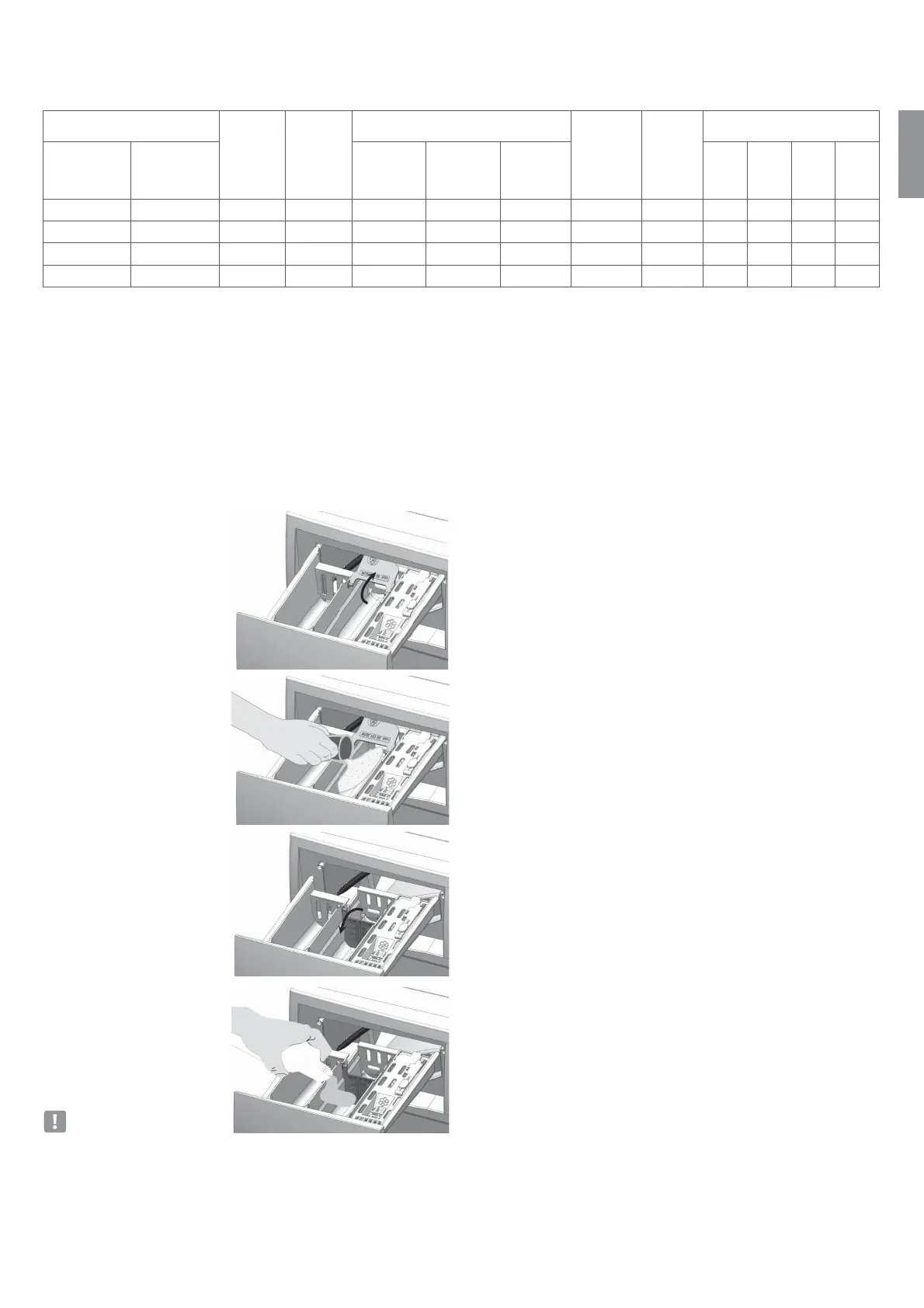
Then place the plate in position:
UP - The position of the plate for the
use of detergent powder
Pour the detergent powder in the
main wash compartment II.
For the amount of detergent pow-
der, always check the details on the
product packaging and make sure
the detergent can be contained in
the dispenser drawer.
DOWN - position of the plate for the
use with liquid detergent
Pour liquid detergent into the main
wash compartment marked II
WARNING!
Do not use the plate in the “DOWN” position (see gure 15):
• With with gelatinous or dense detergent
• With powdered detergent
• Withe prewash programme
• Do not use liquid detergent if the wash cycle does not start immediately.
In such cases use the plate in the “UP” position (see gure 13).
DETERGENT POWDER
Detergent powder is more aggressive than the liquid and undoubtedly less advanta-
geous in in some aspects. It is prepared, usually with rather, strong substances which
also react through particular substances (enzymes) which destroy dirt by detaching
it from the laundry, but does exert any abrasion on the fabric. The laundry washed
with detergent powder, when dried, is rather rough and dry because of these ag-
gressive substances that are absorbed by the fabrics. This requires generally rinsing
with fabric softener. Furthermore, the enzymes may cause allergies in some people
particularly sensitive. Not to mention that it is less soluble, powder of this type of
detergent can be deposited in the dispenser and in the drainage system, causing
the incrustation of the tubes. On the other hand, it is the only detergent that ensures
a pure white washing due to sodium perborate (a strong and aggressive whitening
agent) e ective even at low temperatures (refer to the labelling and the degree of
dirt).
Recommended temperature 30°C - 90°C
LIQUID DETERGENTS
The liquid detergent is undoubtedly the most modern. It possesses superior clean-
ing features. Being less alkaline, it preserves the quality of the fabrics. Although it
does not contain abrasive substances however it cleans nested dirt. Thus, in contrast
to the detergent powder, it cleans without hardening the laundry bres, thanks to
the absence of an insoluble residue that upon drying becomes hard. The laundry is
more soft and therefore require less fabric softener. Furthermore, the liquid deter-
gent does not leave any type of solid residues inside the washing machine and in the
drainage system. Thus eliminating the long standing problem of incrustation and
ruining of the tubes. It washes well also in cold water and is ideal for coloured clothes
because it does not interact with the fabric colours, rather the colour is preserved
and protected with time.
It should be used within temperature range of 0°C and 90°C. The temperature de-
pends on the fabric (refer to the labelling and by grade of dirt). The whiteness e -
ciency is obtained instead only at temperatures above 50°C. In the liquid detergent
there is no sodium perborate, but the optical bleaching agent that works well only
beyond a certain temperature.
Recommended temperature cold - 90°C
SOFTENER
The softener is very high concentrate, which is deposited on the laundry bres and
makes them soft. It should be used sparingly or diluted with water, 50% and more. It
facilitates ironing of clothes washed.
The fragrances are due to di erent essences added to the additive and it does not in
any way impair the ability of cleaning product.
(3) Annual water consumption in litres per year based on 220 standard washing
programme cotton 60 ° C and 40 ° C at full and half load. The actual consumption will
depend on how the washing machine used.
(4) G low e ciency and A higher e ciency
(5) The intensive 60°C and intensive 40°C washing programmes are the standard test
programmes. These programmes are used to clean normally soiled cotton fabrics
and are the most e cient programmes in terms of combined energy and water
consumption.
The appliance complies with the European standards and directives last issued:
Low Voltage Directive (LVD) 2014/35/EU
Electromagnetic Compatibility (EMC) Directive 2014/30/EU and Legislation
Eco-design compatible for elettrodomestics directive 1015/2010/EU
Bekijk gratis de handleiding van Freggia WISL1050, stel vragen en lees de antwoorden op veelvoorkomende problemen, of gebruik onze assistent om sneller informatie in de handleiding te vinden of uitleg te krijgen over specifieke functies.
Productinformatie
| Merk | Freggia |
| Model | WISL1050 |
| Categorie | Wasmachine |
| Taal | Nederlands |
| Grootte | 15226 MB |


